

In 2022, three workers were injured in an arc flash at Google’s Council Bluffs data center while accessing an electrical cabinet. This wasn’t a fledgling operation. This was Google — arguably the world’s most sophisticated data center operator, working with credentialed professionals and following established protocols. Council Bluffs fire officials confirmed the incident, and workers were treated at an area hospital (1).
The protocols weren’t the failure. The project scope wasn’t the failure. The gap was upstream in data center construction safety staffing. Whether the people running the safety program actually know what they’re looking at, and whether they have the leadership credibility to enforce the complex measures these builds demand, is what separates a clean commissioning from a hospital trip.
The Real Cost Breakdown of an Incident on a Data Center Build
The data center construction market hit $240 billion in 2024 and is projected to reach $456 billion by 2030 (3). Booming growth means even more pressure on your site with tighter timelines, complex systems in changing environments, and continually higher stakes. And in the middle of it, you’ve got to hire the right safety professional to supervise a commissioning on a hyperscale facility.
This is not a training problem. It’s a staffing problem. And you simply cannot afford to get the wrong hire. The costs are too great.
Direct costs:
- Medical/workers comp: $500K – $2M per serious injury
- OSHA fines: $15K – $150K or more depending on violation severity
- Legal fees and settlements: $1M – $5M average
Indirect costs:
- Schedule delay on 60MW facility: $3M – $8M per month in lost revenue (4)
- Reputational damage with hyperscalers: Loss of future bids worth $50M – $500M
- Insurance premium increases: 15% – 40% for three years
- Emergency retraining and oversight: $200K – $500K
- Extended regulatory inspections: 30 – 90 additional days
Would you risk an eight-figure outcome on a five-figure staffing decision?
[Talk to a specialist about your current build.]
(Costs approximated based on available data.)
Your Safety Tech Thinks “De-Energized” Means Safe.
It doesn’t.
Another data center construction project means you’re dealing with increasingly complex and overlapping pressures on your site, like energizing switchgear and UPS systems while other trades are still working.
Commissioning poses acute dangers as crews energize switchgear and UPS systems near other trades, risking shocks or arc flashes from misjudged “live” status (5). Arc flashes occur upwards of 30,000 times a year and have led to more than 7,000 burn injuries, 2,000 hospitalizations, and 400 fatalities annually (2).
Your generalist safety hire checked the permit, verified PPE, confirmed lockout/tagout. They don’t know what “live” actually looks like during commissioning because they’ve never supervis+ed electrical work on a hyperscale facility. Now, you’re dealing with a credibility problem for a position that already encounters incredible challenges.
Approved Doesn’t Mean Adequate.
You’re transitioning to lithium-ion batteries for backup power.
Many data centers receiving retrofits from older battery technologies to lithium-ion batteries do not have a two-hour rated fire separation between the battery room and the rest of the data center (6), the requirement under NFPA 855 for installations over 600 kWh.
Imagine your safety hire approved the battery installation because it passed inspection, i.e. the barrier exists. But what they didn’t verify is whether that barrier is actually two-hour fire-rated construction or just standard drywall that looks the same from the outside.
Selecting the right person who knows when to push back on an inspection report is crucial. It’s not just about understanding lithium-ion ESS installations, but knowing how to have difficult conversations with a GC who wants to stay on schedule.
Your Confined Space Permit Was Accurate At 7 AM. It’s Wrong By 10.
Confined spaces like vaults demand atmosphere tests for low oxygen or toxins (5). Your under-floor cable routing qualifies as permit-required confined space. Your safety tech ran the atmospheric monitoring at entry and signed the permit.
By 10 AM, someone’s running adhesive work two rooms over and the HVAC commissioning is pulling those vapors into the plenum where your crew is working. The LEL stays below action level. Your safety tech doesn’t retest because they don’t know that permit-required confined spaces in data centers behave differently when you’re commissioning ventilation systems around active construction.
Someone who’s supervised confined space entries during data center commissioning knows to retest the atmosphere every time HVAC status changes, knows what “normal” airflow sounds like in an under-floor space, and knows that continuous monitoring isn’t optional when you have upstream work happening.
The Data Center Safety Staffing Gap
Over 500,000 skilled tradespeople are needed to meet demand, but 60% report little or no instruction in Energy Control (LOTO) or commissioning safety (7). That’s not a training gap. That’s a staffing gap.
HR departments and generalist staffing firms recruit safety professionals the same way they recruit accounts payable clerks: keyword match on the resume, availability check, rate negotiation. But they can’t tell you the difference between someone who’s worked hyperscale commissioning and someone who’s worked commercial build-outs.
ResponsAble screens differently. Before a candidate is recommended, we map the project’s specific hazard profile against verified field experience. That means scenario-based interviews, reference checks tied to project type, not just employer, and a placement process that starts with understanding your build before it starts with matching a resume.
Projects can cost upwards of a billion dollars and demand the skills of around 1,500 workers per site (8). You can’t afford the false sense of security that comes from hiring someone who checks compliance boxes but misses actual risks.
Three Questions That Separate Real Expertise from Resume Fluff
If they can’t answer these specifically, you’re exposed:
1. “Walk me through calculating incident energy for arc flash PPE requirements when you have both temporary and permanent power active during commissioning.”
- Wrong answer: References NFPA 70E generally
- Right answer: Explains calculation methodology, coordination study, worst-case scenario assumptions for parallel power sources
2. “What’s the fire separation requirement for lithium-ion ESS over 600 kWh and how do you verify the barrier is rated, not just present?”
- Wrong answer: “I check that there’s a barrier”
- Right answer: Cites NFPA 855, describes actual inspection methodology for fire-rated construction
3. “Describe your atmospheric monitoring protocol for confined spaces when HVAC systems are being commissioned around active work.”
- Wrong answer: “We test at entry”
- Right answer: Continuous monitoring, specific re-test triggers, upstream work coordination requirements
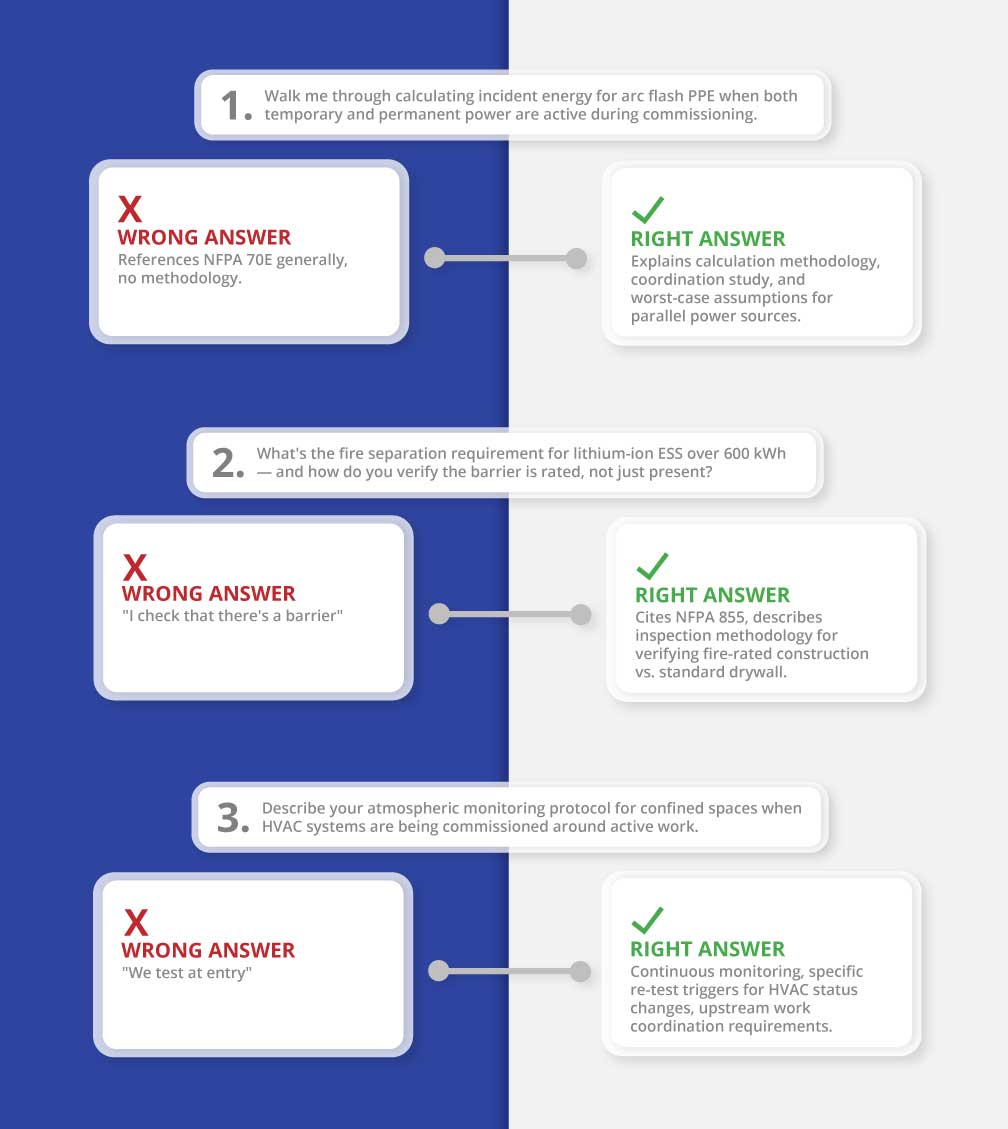
If your current safety staff couldn’t walk you through those answers, you have a gap. However, technical fluency is only half the equation. The other is whether that person will actually stop work when something’s wrong, and whether the crew will listen when they do. That takes communication skills, site presence, and the kind of credibility that comes from having done the job.
As an expert safety staffing agency, ResponsAble always vets for both.
Talk to a Safety Staffing specialist now.
How Hyperscalers Vet Data Center Safety Staffing
Amazon, Microsoft, and Meta aren’t just auditing your safety programs anymore. They’re auditing your safety personnel qualifications. When you place someone through a generalist staffing firm, you’re hoping their resume translates to real capability. When you place someone through ResponsAble, you’re hiring field-tested professionals who’ve supervised the exact work you’re bidding.
Stop Risking What Matters
ResponsAble is a safety staffing firm. That means our expertise is in knowing which professionals are ready for which projects: matching verified field experience to your specific hazard environment, screening for the leadership and communication skills that make technical knowledge actionable on a live site, and placing people who’ve supervised the exact work you’re bidding. Not people who took the course last month. People who’ve supervised commissioning, worked battery retrofits, and stopped work when it needed to stop — and had the credibility to make it stick.
The risks that hurt you aren’t the ones you know about. They’re the ones your safety hire doesn’t know to look for.
Stop risking what matters. Talk to a ResponsAble safety staffing specialist.

Data Center Construction Safety Staffing FAQs
1. How does ResponsAble evaluate candidates beyond certifications?
Our screening process includes scenario-based interviews tied to the specific hazard environment of your project, along with reference checks verified against project type, employer, and a review of how candidates have handled situations in the field. Our goal is to determine whether the candidate has the right combination of safety knowledge, judgment, and presence to execute a safety program on site.
2. What information do you need from us before recommending a candidate?
Before we recommend anyone, we want to understand your project phase, the trades currently on site, the specific hazard exposures you’re managing, and your timeline – to start. That intake process is how we match field experience to your actual risk environment, as well as your job description. The right candidate for a greenfield industrial build is a different profile than the right candidate for a retrofit with active operations running alongside construction.
3. Can you place someone mid-project of a Data Center Construction project, or only at the start of a build?
We place at any phase, and mid-project placements are common. They do require a different candidate profile — someone who can establish credibility quickly with an existing crew, get up to speed on site-specific conditions, and step into an enforcement role without a ramp-up period. That’s part of what we screen for. Availability and credentials are often the easy part.
4. What experience should a safety professional have before working on a hyperscale data center build?
This is exactly the kind of question we help clients answer, and the answer varies by project phase. A candidate supervising civil and structural work needs a different background than one managing commissioning. What we screen for across all data center placements is direct experience with the specific hazard exposures of the phase: energized systems work, lithium-ion ESS installation, confined space entry during active HVAC commissioning, trades overlap management. General construction safety experience isn’t disqualifying, but it’s not sufficient on its own. We won’t recommend a candidate whose field history doesn’t map to the actual risk environment of your build.
5. Hyperscalers are auditing our safety programs more closely than ever. How does ResponsAble help us stay ahead of that?
We can’t speak to what any specific hyperscaler will audit since that’s not our process. However, we can place safety professionals whose qualifications and field experience hold up to scrutiny. That means verified credentials, documented project history, and a comprehensive screening process. When your safety personnel have been vetted the way we vet them, you’ll be prepared in the case of an audit.
Sources
- Data Center Frontier. “Incident at Google Data Center Highlights Risks of Arc Flash.” https://www.datacenterfrontier.com/featured/article/11427156/incident-at-google-data-center-highlights-risks-of-arc-flash
- Compu Dynamics. “The Arc Flash – Preparation and Protection in the Data Center.” May 21, 2024. https://compu-dynamics.com/blog/operations/the-arc-flash-preparation-and-protection-in-the-data-center/
- The Network Installers. “30+ Data Center Construction Statistics, Market Size & Trends (2026).” March 4, 2026. https://thenetworkinstallers.com/blog/data-center-construction-statistics/
- Hammertech. “Data Center Construction Safety: How Contractors Stay in Control.” https://www.hammertech.com/en-us/blog/data-center-construction-safety-key-risks-and-how-contractors-stay-in-control
- Occupational Health & Safety. “Technical Report Details Safety Risks in Data Center Construction.” May 11, 2026. https://ohsonline.com/articles/2026/05/11/technical-report-details-safety-risks-in-data-center-construction.aspx
- Orr Protection. “Lithium Ion Batteries in Data Centers Part 1.” July 12, 2022. https://www.orrprotection.com/mcfp/lithium-ion-batteries-in-data-centers-part-1
- Advancing Data Center EHS 2025. Conference Overview. https://advancing-data-center-ehs.com/
Zurich Resilience Solutions. “The Data Center Boom: Mitigating Risks from Construction to Completion.” August 20, 2025. https://www.zurichresilience.com/knowledge-and-insights-hub/articles/2025/08/data-centers-boom-mitigating-risks-from-construction-to-completion