
Why Turnaround Season Is a High-Risk Window
Turnaround season is unforgiving. And yet safety staffing is often the last thing locked down, even though it’s the first thing that creates liability when it goes wrong.
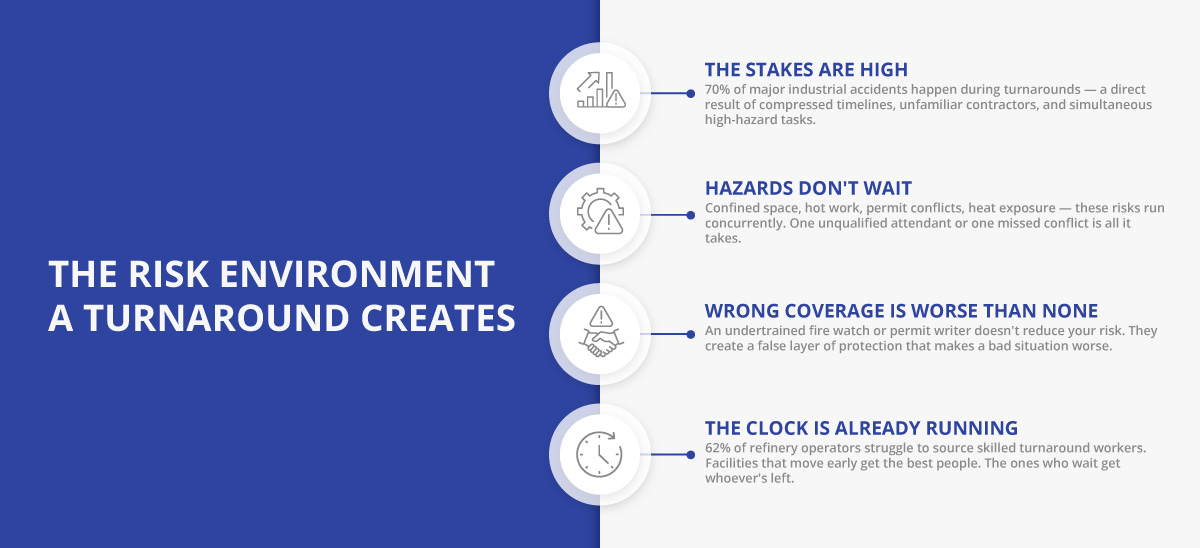
70 percent of major accidents occur during these non-routine operations, even though shut downs account for less than five percent of the year (Industrial Scientific). That’s a direct consequence of compressed timelines, unfamiliar contractors, and simultaneous high-hazard task execution, all without adequate safety coverage in place.
Your facility will face elevated risk during a turnaround. The question is whether the people responsible for managing that risk will be qualified, vetted, and on-site when execution begins, or whether you’ll still be making calls.
The Risk Environment a Turnaround Creates
During a major unit turnaround, as many as 2,000 skilled contractor workers may be brought on-site, and it is not unusual to see staff more than triple (U.S. EIA). These workers don’t know your facility’s blind spots or your permit workflows or your confined space entry protocols. But they’re executing complex, interdependent work at pace in an environment they may have never seen before, creating a specific set of high-probability hazard scenarios that repeat across turnarounds industry-wide:
Confined Space Entry Failures: When No One Is Watching
Vessels, tanks, heat exchangers, and below-grade structures get entered repeatedly during a turnaround — often across multiple units at once. When attendants are unqualified, undertrained, or simply not present, a worker in distress has no one qualified watching.

Hot Work Hazards: Where Fires Actually Start
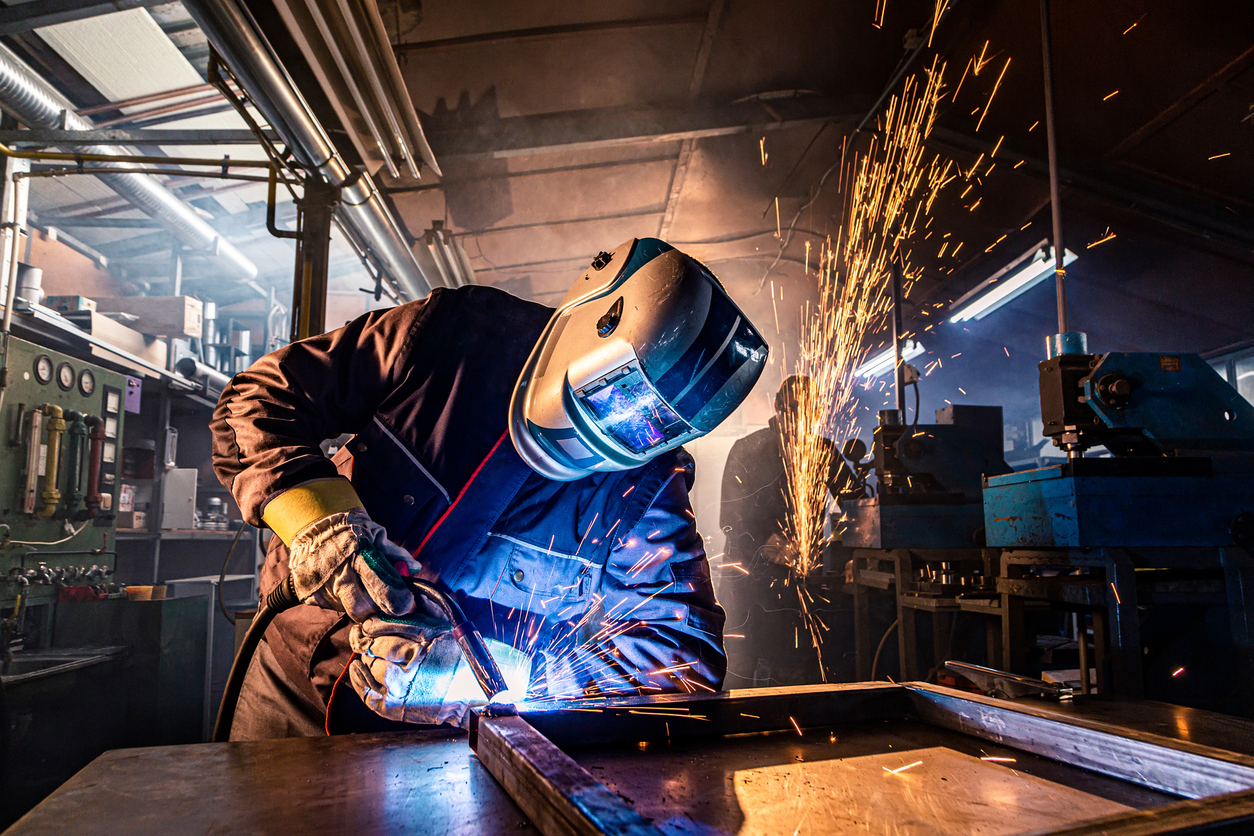
Welding, cutting, and grinding drive turnaround scope. They also create ignition sources in environments still carrying residual hydrocarbons. Fire watch is an active hazard control function, and it’s required. Personnel placed in fire watch roles without industrial training and situational awareness don’t catch the slow burn behind the insulation or the spark that drops into a drain. Can you trust their response after it becomes a fire?
Permit-to-Work Breakdown
A single turnaround at peak execution can generate hundreds of simultaneous active permits. Hot work, confined space, LOTO, line breaks, chemical isolation — each one is a live hazard interaction. Overwhelmed or unqualified permit writers miss concurrent task conflicts. This is where serious incidents compound.
Contractor Hazard Orientation Gaps
OSHA PSM requires employers to communicate known fire, explosion, and toxic release hazards to every contractor on-site. That requirement is only meaningful if the safety professionals managing contractor orientation actually know what they’re doing. An undertrained spotter or safety tech who doesn’t understand your facility’s specific chemical hazard profile is a false layer of protection that can make a bad situation worse.
Heat Exposure
Gulf Coast spring turnarounds mean high-exertion industrial work in conditions that escalate fast. So OSHA’s Heat-Related Hazards NEP is actively in effect and carries enforcement weight. Safety personnel who aren’t monitoring heat exposure alongside process hazards are missing one of the most predictable incident drivers on the calendar.

What Inadequate Safety Coverage Costs You
Beyond the incident risk, the downstream costs are concrete. Without comprehensive safety staffing, you’re looking at:
- OSHA citations under PSM,
- EPA enforcement under RMP,
- workers’ compensation exposure,
- schedule delays from stop-work orders,
- and the reputational damage that follows a serious incident at a facility undergoing planned maintenance.
Why Safety Failures Keep Happening
The EPA estimates that accidental releases from RMP facilities cost more than $540 million per year. Individual incidents have cost single facilities hundreds of millions. The math on investing in qualified safety coverage is not complicated.
In the oil and gas industry, human factors have been identified as the most common causes of catastrophic accidents, and over 30% of major accidents are triggered by inadequate maintenance (Nwankwo, C. D. et al. 2022). Inadequate safety coverage during a turnaround is exactly that category of failure.
The Safety Staffing Shortage Is Structural
Qualified safety professionals, such as confined space attendants, fire watch, permit writers, safety technicians with real industrial experience, are in demand year-round. During spring and fall turnaround seasons, demand spikes across the industry simultaneously. According to a survey by Petrochemical Update, 62% of refinery operators reported difficulties sourcing skilled workers for turnarounds, with labor shortages contributing to project delays and inflated costs.
The facilities that move early get the best people. The ones who wait too long get whoever’s left, or they fill critical roles with unvetted candidates because the clock ran out.
24 – 48 Hours. Nationwide. No Guesswork.
ResponsAble Safety Staffing deploys pre-vetted, certified safety professionals within 24 to 48 hours across Oil & Gas, Chemical Processing, Construction, Power, and General Industrial environments. Every professional is competent and capable on day one.
When your scope expands at T-minus two weeks and you need additional confined space attendants and a permit writer on-site Monday, the answer is yes. No long-term commitments, no scrambling, no gaps.
Roles we staff fast: Safety Technician, Confined Space Attendant, Fire Watch, Permit Writer, Flagger, Spotter, General and Heavy Industrial Labor.
Don’t Let Safety Staffing Be the Last Decision You Make
Build safety coverage requirements into your pre-TAR process with the same discipline you apply to mechanical scope. Know what roles you need, at what headcounts, for which execution phases. Understand your regulatory obligations under PSM and RMP, and make sure the contractors you’re bringing in can document competency, not just certification.
The next season is in view. Get your safety coverage locked before the scramble starts.
Contact ResponsAble Safety Staffing today.
Most temporary safety staffing placements are fulfilled within 24 to 48 hours. For larger-scale turnarounds requiring multiple roles, earlier engagement gives us more runway to match the right people to your specific environment and scope.
Every candidate goes through credential verification, competency evaluation, and background screening before they’re placed. We match qualified professionals to the specific industrial environments and hazard profiles they’re equipped to work in.
Yes. We can add headcount, adjust roles, and redeploy personnel on short notice as your needs evolve.
Yes. We deploy nationwide. Oil & Gas, Chemical Processing, Construction, Power, Nuclear, and General Industrial environments across the U.S.
We staff general contracts, ongoing safety coverage, and short-term project-specific roles year-round