
Most companies heading into summer already have a heat illness prevention plan. They have water, shade, rest breaks, and acclimatization language organized in a binder. But the regulatory pressure is only building: OSHA’s proposed federal Heat Injury and Illness Prevention standard is still working its way through rulemaking, the agency continues to inspect heat hazards under its National Emphasis Program, and a growing list of states continues to enforce their own heat rules. The expectation is clear, whether or not a final federal standard lands soon.

If the protocols already exist, why do workers still go down in the heat?
Usually, it isn’t the plan. It’s the person responsible for making the plan mean something in a 100+ degree setting when the crew is behind schedule. Heat illness prevention can’t only be a document you hand out or a safety talk once a month. It’s an ongoing conversation, every day, with people who may not want to hear it. Not every safety manager is built to hold that conversation.
Heat Illness Prevention Is Not a Checklist
A heat policy outlines what’s expected to happen in a particular situation. But it doesn’t make a foreman call a break when the job is running late, and it doesn’t make a 25-year welder admit he feels dizzy when he’d rather push through.
That’s the real work of heat safety: getting people to change behavior in the moment, under deadline pressure, in environments where crew turnover is fast, and trust has to be constantly rebuilt.
Looking up a regulation is easy, and you almost always have time to do it. Getting a worker to stop an unsafe act when the clock is against you is not. People do what they want. The job isn’t to make them follow the rules. It’s to make them want to be safe.
The site that stays safe in July isn’t the one with the best-written plan. It’s the one with a safety leader the crew actually listens to.
The Gap Most Sites Miss
The failure point often isn’t missing protocol. It’s the highly credentialed safety manager who can recite the protocol but doesn’t have the soft skills to get the crew to buy in.
We’ve seen it many times. A candidate looks excellent on paper, every certification, a clean compliance record, all the right acronyms, and then they get on-site, and they can’t get traction. It doesn’t matter that the plan is sound. The messenger just doesn’t land. Workers nod, check the boxes, and go right back to doing it the way they’ve always done it.
That gap can get expensive fast, and it’s invisible until something goes wrong.
What a Safety Manager Who Connects With the Crew Actually Looks Like
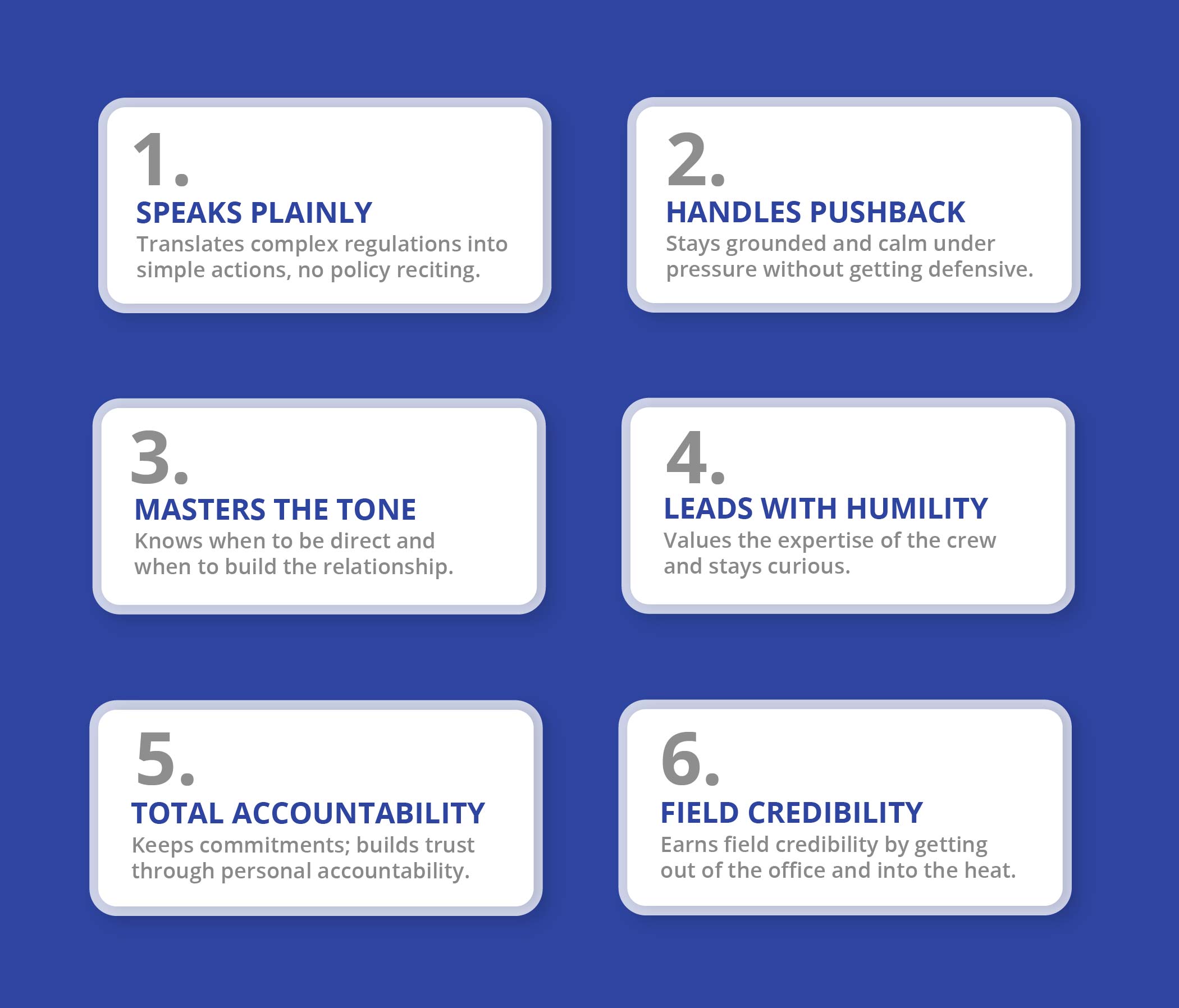
The traits that separate a strong field safety leader from a good test-taker are consistent, and they typically aren’t listed neatly on a resume. You have to know the right questions to ask to determine if a safety candidate is:
- A plain communicator, not a policy reciter: They can translate a regulation into something a crew understands in one sentence and make it meaningful.
- Comfortable with pushback: They can stand before a skeptical crew and take the heat, as it were. They keep their footing without getting defensive or heavy-handed.
- Good judgment about tone: They know when to be direct and stop a job cold, and when to ease in and build the relationship first.
- Real humility: They walk in assuming the fitter, the operator, and the foreman know things they don’t, and they’re genuinely curious about it. Nobody follows a know-it-all.
- Personal accountability: They treat their word as their bond and follow through on their commitments. Every other trait on this list is moot without integrity because a crew stops listening the moment a safety leader says one thing and does another.
- They’ve stood in the heat themselves: Field credibility isn’t something you can fake to a crew that’s living it. No safety leader is effective if they’re chained to their desk all the time.
Underneath it all is something simpler: a good safety manager actually cares about the people on the crew, and the crew can tell. That’s where mutual respect can really grow. That’s what can transform a safety culture from rule enforcement into shared responsibility.
Hire for What You Can’t Train
You can train someone on the heat standard. You can teach acclimatization schedules, heat index thresholds, and first aid for heat stroke. What you can’t train is whether someone genuinely cares about the people in front of them.
That trait either shows up in how a person has worked before, or it doesn’t. It’s a hiring decision, not a curriculum, which is exactly why it has to be screened for at the front end, before a candidate ever sets foot on your site. And it’s foundational to the vetting process we’ve spent over two decades honing at ResponsAble Safety Staffing.
How We Screen for Leadership and Field Presence
Field experience and field presence are not the same thing, and the difference will show up in an interview if you know how to find it.
Our approach is behavioral. We don’t ask candidates whether they value safety, since everyone says yes. Instead, we ask them to walk us through what they’ve actually done.
“Typically, I ask a candidate to tell me about a time they had to stop a job or challenge a supervisor over an obvious safety concern. Someone with only field experience gives you vague generalities pulled straight from a job description,” says Kevin McMann, who conducts candidate screening at ResponsAble.
“Someone with real field presence gets specific: the exact hazard they saw, how they handled the crew, what the resistance was like, how they got past the objections, and what corrective action they took.”
Those details are much harder to fabricate. Then, we pair that with field background verification and pay close attention to how a candidate talks about past crews. Compliance records are only a piece of the puzzle. A candidate who talks about people is usually one who was genuinely connected with them.

What Changes When the Job Is Heat-Heavy Summer Work
When a client specifically needs someone to carry a site through brutal summer conditions or other similar job-site restrictions, the screen tightens in technical expertise with caring leadership.
Kevin looks for things he wouldn’t weigh as heavily on a different placement.
“I ask candidates for documentation they’ve actually used, like what kinds of toolbox talks and training sessions were built specifically around heat stress. I ask them to describe the warning signs a worker shows before heat stress and fatigue set in. How do they approach first aid for someone already suffering?”
He also looks for relevant environmental experience, such as time spent working in the deserts of the southwestern U.S. or in comparable conditions overseas. The goal is to put someone on your site who has already done this work where it’s hardest, not someone learning it on your crew in July or August.
Don’t Wait Until Mid-July to Find Out Who’s Covering Your Site in August
Safety is a misleading profession because when you’ve got great heat coverage, there’s little fanfare. There’s no incident, no near miss, no scary story to tell. But you’ve got a hardworking crew that made it through another brutal shift and went home. Do the job right, and it stays invisible, which is exactly why it’s so easy to under-hire for until the summer you don’t.
Summer placements fill fast, and the candidates who can actually connect with a crew in the heat go first. If you’re not already talking through who’s covering your high-heat sites this season, our safety recruiters can help.
If you’d like a sense of what strong, field-credible heat coverage looks like for your operation, ResponsAble is happy to talk it through so you have a cool head and a clear picture before the temperature climbs.
Beyond certifications, the strongest heat-site safety managers are effective communicators who can get a crew to listen and engage, and are comfortable with pushback. Most importantly, they genuinely care about the people on site, and they’ve done the work in the heat themselves, so the crew trusts them.
It depends on how seasonal your heat exposure is. Sites with year-round hazards usually justify a permanent hire, while operations that spike in summer often use contract or temporary safety professionals to scale coverage for the hottest months without incurring year-round costs.
Early signs include heavy sweating, muscle cramps, headache, dizziness, nausea, and unusual fatigue or irritability. Warning signs that have become serious, such as confusion, slurred speech, fainting, or hot, dry skin, can indicate heat stroke, a medical emergency requiring an immediate 911 call.
Usually, the plan isn’t the problem; it’s the poor execution. A policy can’t make someone change their behavior. That depends on a safety leader the crew actually listens to. When the messenger doesn’t land, workers are more likely to comply on paper and cut corners in practice.
Use behavioral questions. Ask a candidate to describe a specific time they stopped a job or challenged a supervisor over a hazard. Candidates with real field presence provide concrete details such as the exact hazard, how they handled the crew, the resistance, and the corrective action.
Earlier than you’d think. Summer placements fill fast, and waiting until temperatures climb usually means choosing from who’s left. If you’re hiring for July and August, the conversation should be happening well before then.