
AI has surged into the safety staffing and EHS industry in 2026 with promises to transform some of the core processes with powerful automation. Already underway in the industry, credential screening, risk assessment, and predictive maintenance harness AI to drive efficiency. And explorations of how to apply hazardous material detection, safety training, and emergency response with new automation enhancements offer additional insights into industry best practices as well. As these technological marvels reshape the industry, we continue to assert a crucial principle at ResponsAble Safety Staffing: automation should empower human work, not replace it. The path forward pairs AI’s analytical prowess with the seasoned judgment of human experts.
The Mechanics of Filling a Role
For example, we recently published a guide, How to Hire an EHS Director, which weighs factors like what makes an open role expensive, the credential stack that separates a viable candidate from a strong one, and the tradeoffs between the types of contracts. But an important element to consider remains: as AI grows in capability and usage, what can you outsource, and what should hiring managers be screening for?
Where Does AI Belong in the Safety Workflow?
With so much automation now on the table, what is the relationship between AI and human expertise? What’s the right balance to mitigate client risk?
We are in the business of keeping people safe, and sometimes the available technology lends itself well to streamlining administrative tasks and first-touch reviews of qualified candidates. However, the deciding factors for what qualifies someone to perform well and thrive in a leadership role are much more of a sliding spectrum, which requires diligence and human judgment. Technology, when used properly, supports the work of our recruiters and sometimes expedites the process. It can even enable them to spend more time in the subjective work of determining the best cultural fit for a particular organization.
Industry leaders echo this human-forward philosophy as they integrate AI into their operations. In manufacturing, predictive maintenance models crunch terabytes of sensor data to pinpoint failure risks. But determining which risks justify halting production to intervene still requires a manager’s call based on experience and context. The AI informs that decision, but it doesn’t make the call. In oil and gas, computer vision and infrared spectroscopy have sharpened hazardous material detection. But assessing exposure impact and mitigation options across facilities takes veteran safety engineers interpreting those scans. The tech amplifies their expertise, but it’s not automating it away.
Why AI Raises the Bar on Human Judgment
As AI permeates safety processes, its expanding influence demands even more practiced human judgment to apply it effectively. Far from diminishing the need for seasoned safety professionals, the infusion of AI elevates their value. For safety staffing, this means hiring profiles are evolving. Critical traits now factor in heavily alongside traditional safety and compliance know-how. The most sought-after candidates can deftly wield soft skills, industry expertise, and technological integration to improve their core safety responsibilities.
What This Means for Hiring Managers
As safety hiring managers navigate this shifting landscape, ResponsAble offers vital partnership and perspective. Our pro-technology, pro-human stance informs our rigorous screening and matching practices. But these tools can only be applied optimally when paired with extensive behavioral interviewing. The goal process wields cutting-edge technology as a tool while always keeping people at the center. As 2026 heads to a close, expect this human-forward paradigm to entrench across the safety and industrial ecosystem. Successful organizations will embrace the expanding capabilities insofar as they can be grounded in practiced human wisdom. The winners will align around a maxim ResponsAble will continue to uphold: the smarter the tech, the more vital the people guiding it.
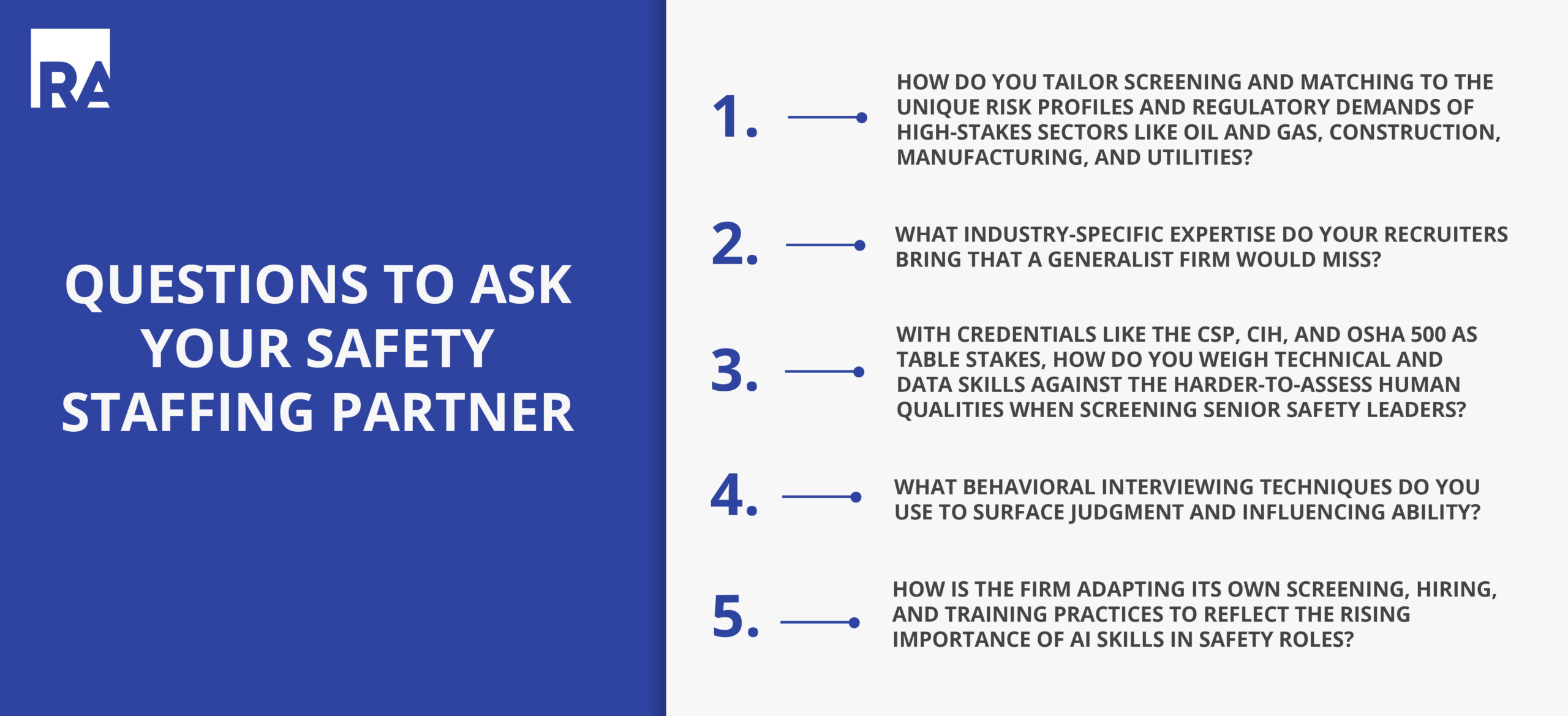
Questions To Ask Your Safety Staffing Partner
If AI has the potential to reshape how safety leaders are found, vetted, and placed, then how a staffing partner answers these questions matters more than ever. Here are five we think every hiring manager should be putting to their recruiter:
- How do you tailor screening and matching to the unique risk profiles and regulatory demands of high-stakes sectors like oil and gas, construction, manufacturing, and utilities?
- What industry-specific expertise do your recruiters bring that a generalist firm would miss?
- With credentials like the CSP, CIH, and OSHA 500 as table stakes, how do you weigh technical and data skills against the harder-to-assess human qualities when screening senior safety leaders?
- What behavioral interviewing techniques do you use to surface judgment and influencing ability?
- How is the firm adapting its own screening, hiring, and training practices to reflect the rising importance of AI skills in safety roles?
Let’s Talk About Your Next Safety Leader
Whether you’re rethinking what your safety leadership bench should look like in a tech-forward climate or filling a critical seat that can’t stay open any longer, we’re ready with a staffing solution. Our recruiters at ResponsAble work across industries, from construction safety staffing to power and utilities. Temp hire or long-term contract, we have a bench of safety professionals to fit your needs.
Reach out to start a conversation.
No. As AI takes on more of the detection and monitoring work, the volume of signal an EHS leader has to interpret goes up, not down. Someone still has to decide which alerts warrant a work stoppage, and which patterns point to a cultural problem. And there will always be recommendations that the technology got wrong.
Ask them to walk you through a specific decision they made. Candidates with real fluency describe the limitations and the positive outcomes. Candidates who lean on buzzwords tend to stall when you press for the judgment layer.
Yes, but it depends. Comfort with data analysis and AI-enabled tools is quickly moving from a differentiator to a baseline expectation. That doesn’t mean every safety professional needs to write code. It means they need to know what these tools can and can’t do, how to interpret their outputs critically, and how to fold them into existing safety programs without letting the technology set the priorities.
Prioritize candidates who understand where the industry is heading, even if your organization hasn’t gotten there. An EHS Director hired today will likely be the person leading your first AI adoption decisions in the next two or three years. Screen for curiosity about the technology, an ability to evaluate vendors critically, and an informed opinion about where automation belongs.