
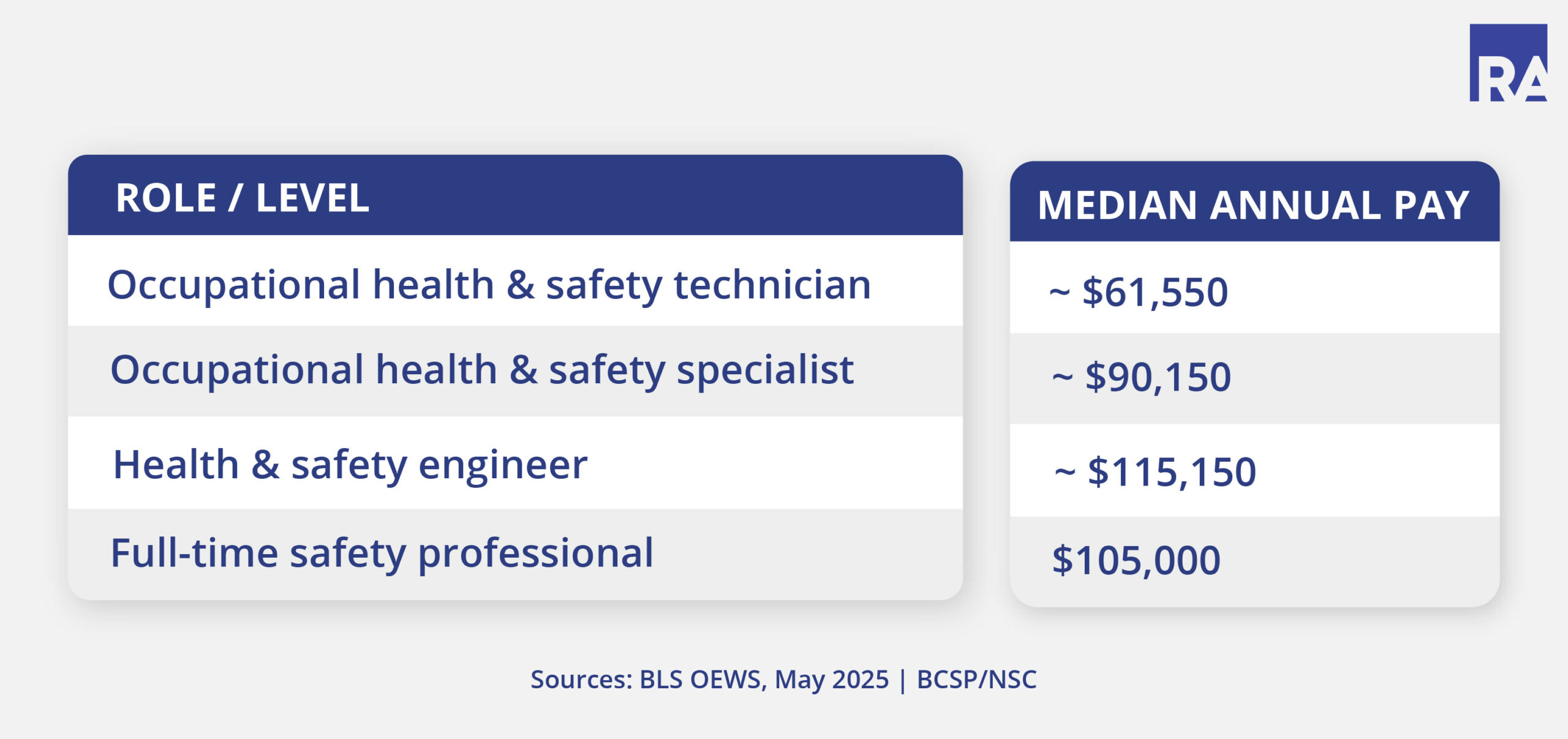
Key Takeaway: In 2026, compensation for safety professionals varies by tens of thousands of dollars depending on the credentials, industry, regional placement, and the type of role. Last year, the Bureau of Labor Statistics put the median for occupational health and safety specialists at approximately $90,150, up from 2024’s $83,910. The industry’s own BCSP salary survey put the median for full-time safety professionals at $105,000, with certified safety professionals earning even more. Our own placement rates land right on top of these numbers. Whether you’re looking for a starting point or confirming if your offer is enough, you need to know the competitive market rates for the roles you’re filling. Without due diligence, the possibility of disaster begins with overpaying the wrong hire or lowballing the perfect fit. Let’s review the trends for safety professional earning potential and what it means for your next hire.
What is the average safety professional salary in 2026?
There is no one average because the umbrella term “safety professional” encompasses a wide variety of industry experience, credentials, and job type. The reality is that accurately measuring what different safety professionals earn is much more complex.
Safety pay is not stagnant, especially for two of the most common positions we fill. In its most recent publication, the Bureau of Labor Statistics reports a median wage of about $90,150 a year for occupational health and safety specialists, and about $61,550 for technicians at the field-level tier. The specialist rate jumped significantly, increasing more than 7 percent in just one year.
The Board of Certified Safety Professionals set the benchmark higher because it measures a more heavily credentialed workforce. The most recent BCSP and National Safety Council salary survey puts the median base salary for full-time safety professionals at $105,000. Other hiring platforms, like Glassdoor, average higher at $113,683 for specialists and top earners over $195,000.
What’s Driving Salary Growth?
It’s a wide range that matches the trends we’re seeing with client work.
ResponsAble Executive Recruiter Kevin McCann puts specialists on contract or direct hire at $42.50 to $50.50 an hour, which is roughly $88,000 to $105,000 a year. This fully brackets the BLS median and the survey’s credentialed figure.
The public data isn’t overestimating, but what is causing the increase?
The trend is up due to the boom in data centers.
“Rates have increased this year due to GCs that are building data centers and requiring BCSP certifications. We have seen an increase of about $8–$10 per hour.” — Kevin McCann, Executive Recruiter, ResponsAble Safety Staffing.
As general contractors pull more certified professionals out of the same pool, this affects the rest of the market. ResponsAble safety staffing experts, like Neil Lemoine, note that even temp hire candidates are commanding rates above the average. Due to the boom in data centers and warehousing and logistics, those safety professionals are being placed faster than the market can resupply them.
The number to pay attention to largely depends on what type of hire you need. Many project hires are tracking along with the public medians, but temp coverage is fluctuating with the exponential demand and urgency of data center construction.
How much more do certified safety professionals earn?
Certified safety professionals earn significantly more than average safety professionals, but other market factors can also greatly affect compensation.
According to the BCSP/NSC survey, safety professionals with at least one recognized certification earn $18,000 more per year on average than those without one. The Certified Safety Professional (CSP) typically adds more than $30,000 to the salary of a practitioner holding no other credentials. And CSP and Safety Management Specialist (SMS) holders report a median salary of $120,000.
There’s a good reason why companies pay a premium for these candidates. It’s because the people who earn a CSP almost always bring years of quality experience to match it.
“The CSP is the gold standard,” says Kevin McCann, Executive Recruiter.
However, the certification isn’t the universal indicator for higher pay. When faced with a binary choice, clients seek out proven experience over top credentials. On the temp and turnaround side of safety staffing, Neil Lemoine often sees clients prioritize someone with substantial field experience over certifications alone, even a CHST or OHST.
Pay the CSP premium when the role needs a program leader. Don’t overpay for it when the job needs a seasoned field hand. Knowing which is which is key. If you’re not confident about what your job req needs, that’s exactly what our safety staffing experts can help you with.
At ResponsAbLe, our recruiters provide vetted, credentialed candidates with real experience plus the insight you need to determine the best culture fit. Let’s talk about your next hire.
Which industries pay safety professionals the most?
Higher-risk environments offer higher compensation, so industries like oil and gas and chemical processing often lead the pack.
- Oil & Gas: Occupational health and safety specialists in oil and gas extraction average $121,000.
- Defense: Defense sectors pay 20 percent more than the industry average for CSPs.
- Construction: Construction runs $80,000 to $90,000 at the officer level, though senior construction safety directors reach $175,000 to $210,000 and beyond on complex industrial projects.
It’s no surprise to see these mammoth industries ranking as the top-paying sectors in safety staffing, but trends have shifted. Safety professionals in construction tend to be contract hires, while those in petrochemical are usually more long-term, direct placements. Kevin McCann noted that his petrochemical clients have raised compensation to compete with each other.
Other industries are rising as the new behemoths: data centers, warehousing and logistics, and aerospace. While the hazard-equals-pay rule still holds, the highest demand is following the build-outs.
What do contract and turnaround safety professionals earn?
Contract and turnaround roles are priced by the hour or the day.
Along the Gulf Coast, compensation trends for contract and turnaround safety professionals vary widely. In Houston, per-diem refinery safety roles average $30.92 an hour in 2026, with most between $24 and $37 and specialty work reaching $60. In Baton Rouge, one major plant-services contractor lists turnaround safety technician pay at $51,647 to $68,277. The pay aims to reflect the intensive pace of 12-hour shifts, seven days a week for the duration of an outage.
Turnaround and contract work is planned, but sometimes that doesn’t equate to proactive hiring. The biggest risk of reactive hiring isn’t overpaying, but staffing with low-quality safety professionals. When clients hand over scope at the last minute, they compress the window to build a qualified field slate under pressure. That compression adds unnecessary strain to a process, and it’s exactly when a bad hire can slip through and create costs.
Why is there such a wide range in safety salaries?
The “safety professional” is not one particular job. The umbrella title includes a fresh OSHA 30 card-holder running field observations and a CSP running a site-wide program with stop-work authority.
Here are the four variables that most impact salary and compensation:
- Credential tier: OSHA 10/30 at the base, technician credentials (CHST, OHST) in the middle, professional credentials (CSP, SMS, CIH) at the top.
- Industry and hazard profile: Oil, gas, chemical, and power pay a premium over lower-risk sectors. And in 2026, data centers, warehousing, and aerospace are bidding hard for the same people, driving up the numbers with compensation.
- Region: Gulf Coast refining, high-cost metros, and strong-enforcement states pay well above the national baseline.
- Employment structure: Direct-hire salary, project placement, and contract turnaround will influence the salary or price of a safety hire in different ways.
Once you stack those variables, one job title could realistically be in the $60,000 range. Looking up a generic salary average is a decent starting point, but it doesn’t provide you with the full picture or the best job description to entice the right safety hire for the position you need to fill.
What does this mean before you write your next req?
Getting something wrong always comes with a cost. But when it involves the wrong safety hire, the number is bigger than many hiring managers expect.
ResponsAble’s Neil Lemoine puts a figure on a wrong hire:
“If the client or we select the wrong candidate, the financial impact could exceed $6,780 per week when factoring in wages, per diem, and travel pay.”
Neil Lemoine, COSS, Business Development, ResponsAble Safety Staffing
That’s before accounting for the operational hit of pulling that person and restarting the search. Kevin McCann sees the same failure from the other side: the clients who undervalue the role burn weeks in a recruiting cycle that stalls out, then come to ResponsAble after exhausting their own bench, at which point the fix starts with accurate salary data for their industry and geographic region.
Price the req below the real regional and sector rate, and it sits open, or it fills with someone who doesn’t match the hazard profile.
Anchor to a national average while staffing a Gulf Coast turnaround in a market where data-center GCs are outbidding you for the same certified people, and you’ve mispriced the role before a candidate sees it.
Pay a full CSP premium for a program that needed a strong field technician, and you’ve overspent on paper. Each one is a budget written against the wrong number.
How should you position your next safety hire?
Getting safety staffing right is a particular skill. It means knowing what a credential is worth in your region, which certifications map to your risk profile, and the difference between a candidate who looks right on paper and one who’s proven it in the field. Most hiring managers don’t have time to build that expertise on the side while running operations.
Safety staffing is the only thing we do. ResponsAble keeps a live national bench of credentialed, field-tested safety professionals and prices every placement against what the market is doing. If you don’t know the number before you write the req, we do.
Talk to a safety staffing specialist before your next hire.
Frequently Asked Questions
It depends on the role. Pay the CSP premium when you need a program leader with stop-work authority and site-wide responsibility. When the job is field observation and hands-on hazard recognition, proven experience often matters more than the top credential. The mistake is defaulting to one rule for every req. Match the credential tier to what the role demands.
Include the certifications that map to your hazard profile, not the longest list you can ask for. OSHA 10/30 is a baseline, technician credentials like CHST and OHST sit in the middle, and professional credentials like CSP, SMS, and CIH are the top tier. A refinery turnaround, a data center build, and a solar field don’t need the same slate. Requiring credentials the role doesn’t use narrows your candidate pool and inflates your budget.
Anchor it to your region, industry, and the specific credential. A number that looks generous against the national median can still sit below market on a Gulf Coast turnaround where data center general contractors are outbidding you for the same certified people. If the req has been open for a while, that can be a sign it’s not priced appropriately. Current regional and sector rates are exactly what a staffing specialist can confirm before you post.
For temp and turnaround coverage, we deploy pre-vetted, certified professionals nationwide within 24 to 48 hours. That speed comes from keeping a live national bench year-round rather than starting the search when your scope expands. Project Hire placements take longer because fit and vetting are the whole point, but they still move faster when the bench already exists.
When the role calls for one, yes, you’re paying for a certain level of expertise, and people who earn a CSP almost always bring years of experience to match it, as our safety staffing experts can attest. The premium becomes a waste only when you attach it to a job that doesn’t require a CSP.
It’s difficult to quantify the exact financial impact depending on the factors. Consider wages, per diem, and travel pay. Then add in the operational hit of pulling the wrong safety professional and restarting the search. The possibility of downtime will exponentially increase the cost of a bad hire. The cost of getting it right is always smaller than the cost of getting it wrong.
Stack the variables that move pay: a professional credential like a CSP, experience in a high-hazard sector such as oil, gas, or chemical processing. Be willing to work where demand is outrunning supply, which right now includes data centers, warehousing, and aerospace. Seek out field experience that proves you perform under pressure, not just on paper, and that will enable you to command rates above average. Placement with a safety staffing firm that knows your worth in your region does the rest.