
Introduction
If you want to learn about OSHA’s requirements for hard hats, you’re in the right place. Edward Buller gave us the hard hat in America in 1919. Called the Hard-Boiled Hat, this canvas and leather headgear was the first commercially available head protection device. Now worn by millions of workers, Bullard’s hard hat revolutionized the safety-product industry, earning him a spot in the National Inventors Hall of Fame.
“Bullard’s invention came at an important time,” says Peter Liebhold, curator in the Division of Work & Industry at the Smithsonian’s National Museum of American History, which has three examples of the Bullard hard hat in its Mining Lights and Hats collection. “Mines were one of the first regulated workplaces in America. His hard hat protected employees and limited the liability against employers.”
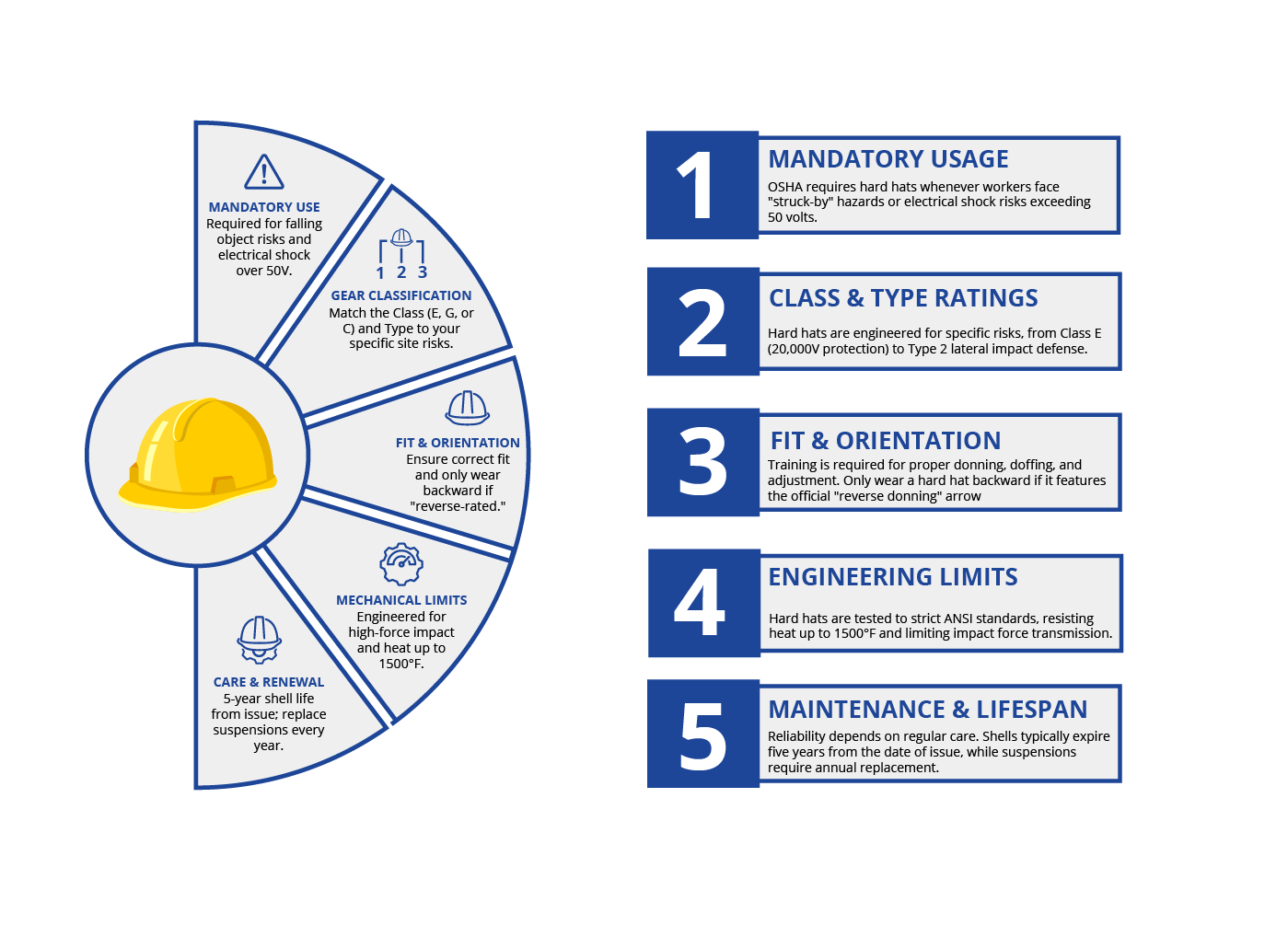
What are the five most vital facts a company and a worker should know about their hard hats?
Number One
When are hard hats required?
There are two basic hazards in the workplace when OSHA says that the employer should provide and require the wearing of hard hats. They are struck by hazards (ex: struck by falling objects) and electrical shock (ex: voltage over 50 volts).
Number Two
What hard hats are required?
Hard hats are designed, engineered and sold in three classes: Class E, Class G, and Class C.
- A Class E hard hat protects from impact to the head and additional protection from electrical shock up to 20,000 volts.
- A Class G hard hat protects from impact to the head and up to 2,200 volts of electricity.
- A Class C hard hat protects from impacts but has no electrical safety protection.
Hard hats also are designed, engineered and sold in two types:
- ANSI Type 1 hard hats meet stringent vertical impact and penetration requirements.
- ANSE Type 2 hard hats meet vertical and lateral impact and penetration requirements, and have a foam inner liner made of expanded polystyrene (EPS).
Number Three
How do you properly don, doff, adjust, and wear a hard hat?
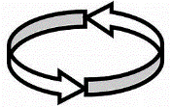
OSHA requires that employers train workers on how to don (put on) and doff (take off), adjust, and wear a hard hat. Some hard hats are allowed to be worn backwards if the label on the inside shell shows that it was designed to be worn in that manner. Reverse donning hard hats are marked with a “reverse donning arrow”. They can be worn frontward or backward in accordance with the manufacturer’s wearing instructions. They pass all hard hat protection requirements whether worn frontward or backward. Here is the logo.
Number Four
What are the limitations of a hard hat?
This is a tricky one. All manufacturers of hard hats must proof test a certain number of manufactured hard hats to a uniform standard: ANSI/ISEA Z89.1-2014. The standard sets guidelines for design and material.
Here are a few of the ANSI standard test requirements:
- Helmets shall not transmit a force to the test head form that exceeds 4450 N (1000 lbf) (pound for feet). Maximum transmitted force of each individual test sample shall be averaged. The averaged values shall not exceed 3780 N (850 lbf) (pound for feet).
- Hard hats must resist heat up to at least 1500 degrees.
Number Five
What are the requirements for proper care, maintenance, useful life, and disposal of hard hats?
Hard hats should be cleaned with mild soap and water and inspected on a regular basis. The useful life of a hard hat has been misrepresented among many employers.
Here is the bottom line: manufacturers recommend replacement after 5 years of use. In other words, the useful life of a hard hart starts at the time of issue not the manufactures’ stamped date on the brim. Most suspensions in a hard hat are required to be replaced every year. Follow manufacturer’s instructions.
Finally
If you just do not want or like to wear a hard hat, you can be exempted( just kidding). Your head just must pass the following test:
- First you will undergo a 24-hour underwater test. Maximum permitted absorption is 0.5 percent by weight. Air will be furnished by the company for the 24 hours at no extra charge.
- Passing that, an impact test will be conducted. While lying horizontal with your head resting on a steel plate, an 8-pound steel ball must be dropped 5 feet several times with no damage to your head.
- Next, your head will be subjected to a variety of acids, solvents, oils and industrial gases. It must pass with no damage or deformities.
- A propane torch will be used to determine if your head is fire resistant.
- If there are any holes in your head, it will restrict you from a class B rating.
- For the final test, you must sustain 2200 volts AC, 60 Hz, for three minutes with leakage currents not exceeding nine milliampres. Breakdown threshold has been established at 30,000 volts.
- All tests must be conducted at a variety of temperatures ranging from -20 to 140 degrees Fahrenheit.
If you don’t feel you can qualify, don’t despair. Although not as pretty as your hairdo, your hard hat does provide protection for your head from all the above.
Remember, unless you receive an exemption certificate, you must continue wearing your hard hat. Not wearing one is a privilege that will be given only to those who undergo proper certification and are designated: “HARD HEADS”.
Hard Hat Warnings and Precautions Summary
- Never alter or modify the hard hat shell or suspension. This can drastically reduce the amount of protection provided. Drilling holes in the hard hat shell for ventilation purposes is always prohibited.
- Always avoid contact of the hard hat with electrical wires.
- Never use a suspension that is not intended for use with a particular shell or one that is made by a different manufacturer.
- Never carry or wear anything inside of your hard hat between the suspension and the shell. A clearance must be maintained between the hard hat shell and the wearer’s head for the protection system to work properly. A ball cap or other object may limit this clearance. An object placed under the cap may also contain metal parts that may diminish the dielectric protection provided by the hat. There are some products, such as winter liners and sunshades that are designed specifically to work in conjunction with hard hats. Be sure to follow manufacturer’s recommendations for the use of these products.
Frequently Asked Questions
When are hard hats required by OSHA?
OSHA requires hard hats when workers are exposed to falling objects, impact hazards, or electrical shock risks. Employers must provide head protection when there is a potential for employees to be struck by objects or when working near electrical conductors with voltages over 50 volts.
What are the different classes of hard hats?
Hard hats are classified into three categories based on their level of protection:
- Class E (Electrical): Protects against electrical hazards up to 20,000 volts
- Class G (General): Provides protection up to 2,200 volts
- Class C (Conductive): Protects against impact but does not provide electrical protection
Selecting the proper class depends on the hazards present in the workplace.
What is the difference between Type 1 and Type 2 hard hats?
Hard hats are also categorized by impact protection design:
- Type 1 hard hats: Protect against impacts from the top of the head
- Type 2 hard hats: Provide protection from both top and side impacts and typically include additional foam padding inside the shell
Type 2 hard hats are becoming more common on modern jobsites because they provide enhanced protection.
Can hard hats be worn backwards?
Some hard hats are designed to be worn either forward or backward. If a hard hat is approved for reverse wear, it will have a reverse donning arrow on the inside label. Workers should always follow the manufacturer’s instructions to ensure the hard hat maintains its safety rating.
What OSHA standard applies to hard hats?
OSHA requires head protection that meets the ANSI/ISEA Z89.1 standard, which establishes performance requirements for impact resistance, penetration resistance, and electrical insulation. Employers must ensure that hard hats used on the jobsite comply with this recognized safety standard.
How often should hard hats be replaced?
Most manufacturers recommend replacing hard hat shells every five years from the date the employee begins using the helmet. The suspension system inside the hard hat often needs to be replaced annually. However, hard hats should be replaced sooner if they show signs of damage, cracks, fading, or exposure to harsh chemicals or extreme temperatures.
How should hard hats be inspected and maintained?
Hard hats should be inspected regularly for cracks, dents, brittleness, fading, or damaged suspension systems. They should be cleaned with mild soap and water, and workers should avoid using harsh chemicals that could weaken the protective material.
Can workers modify their hard hats?
No. Hard hats should never be modified or altered. Drilling holes, painting with non-approved coatings, or attaching incompatible accessories can weaken the shell and reduce its protective capabilities. Workers should only use accessories that are approved by the manufacturer.
Can you wear items under a hard hat?
Items placed between the hard hat suspension and the shell can interfere with its protective function. Workers should avoid wearing items such as ball caps or objects that reduce the clearance between the shell and the head. Only manufacturer-approved accessories like winter liners or sunshades should be used.
Why are hard hats important for workplace safety?
Hard hats help protect workers from head injuries caused by falling objects, impact hazards, and electrical exposure. They are one of the most essential forms of personal protective equipment (PPE) used in industries such as construction, manufacturing, utilities, and industrial operations.